

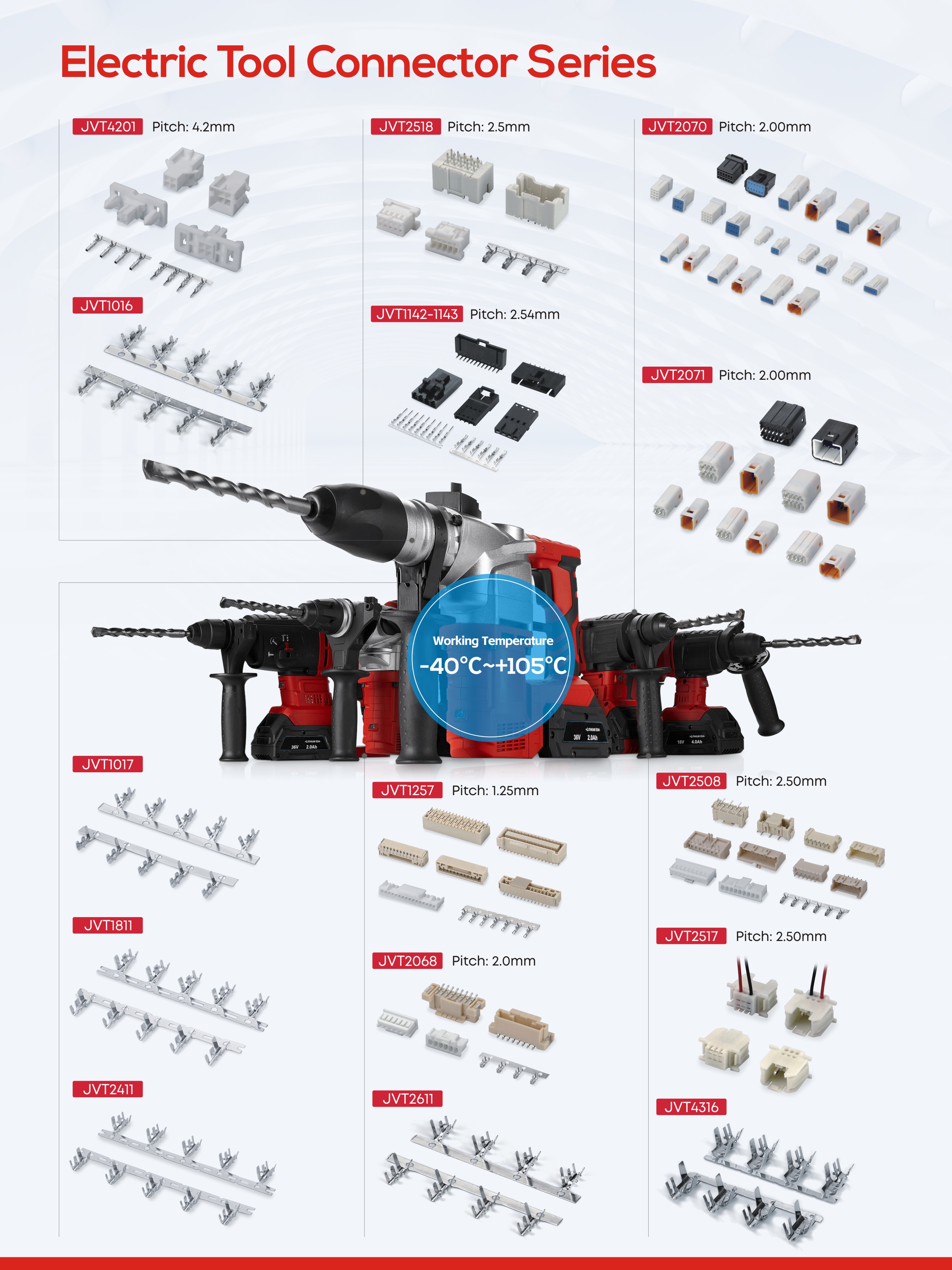
A cordless power tool connector has to survive the two things that destroy connections fastest: sustained hand-arm vibration and repeated mating. On a professional tool platform covering drills, angle grinders, and garden equipment, the customer had specifications that read like a test plan rather than a datasheet: repeated battery swaps, hand-transmitted vibration from the tool itself, and use in rain on outdoor sites. Their previous interface had been chosen mainly for current capacity, and the service data showed intermittent loss of power that traced back to terminals rather than to the battery cells.
This case study explains what a tool battery interface actually endures, why a double locking structure matters more than a stronger spring, and what the project reported after changing to the JVT2071 sealed wire-to-wire family. It is written for engineers and buyers specifying connections for cordless tools, garden equipment, and battery packs that are handled by professionals.
What a Cordless Power Tool Connector Endures in a Working Day
Professional tools are used differently from consumer tools, and the difference shows up at the connector rather than in the motor.
- Mating cycles that add up quickly. A contractor with two battery packs may swap them dozens of times a day. Over a year, that is a four figure number of mating cycles on a part that most designs treat as a once-a-day event.
- Vibration the tool generates itself. A grinder or a hammer drill transmits a significant amount of energy into the housing, and the battery interface sits at the end of that path. Contacts that rely on friction alone will fret.
- Rain, dust, and site conditions. Outdoor work means water on the housing and fine dust in the battery bay. Water plus mineral dust is conductive, and once it reaches the terminals it starts the corrosion process that eventually raises contact resistance.
- High discharge current. A professional tool pulls current in short, heavy bursts, so the interface sees a duty cycle of thermal pulses rather than a steady load.
Put those four together and the requirement stops being about contact rating. It becomes about retention, sealing, and plating, because those three decide whether the contact resistance is still the same after a year as it was on the first day.
Why the Double Lock Structure Was the Decisive Change
The instinct when a connection works loose is to add spring force. That helps for a while and then works against you, because stiffer terminals are harder to mate, they wear the plating faster, and the operator starts forcing the battery into place. A double locking structure solves the problem differently: it keeps the housings mechanically engaged in two independent ways, so retention does not depend on a single latch surviving a thousand drops.
Two retention features instead of one
On the JVT2071 family supplied for this platform, the primary latch does the everyday work and the secondary feature provides the backup. If the primary is worn or the housing is deformed by heat, the secondary keeps the interface fully mated, which is the difference between a slightly loose battery and a tool that stops mid-cut.
Sealing for rain, not for immersion
The tools on this platform are specified as IP67 for outdoor work, which covers rain and splash on a wet site. Sealing at the battery interface keeps water and dust away from the terminals, and it also keeps fine abrasive dust out of the contact area, which is the quieter half of the benefit.
Plating that holds resistance across cycles
With a heavy current pulse every time the trigger is pressed, plating wear is inevitable. What matters is how much the contact resistance changes as that wear accumulates. The customer tested the interface over repeated mating cycles and recorded a change of less than five percent in contact resistance, which is the figure that convinced them to roll the change out across the platform.
Interface configuration for this platform
Connector family: JVT2071 sealed wire-to-wire pair between the battery pack and the tool housing.
Retention: double locking structure with a primary latch and a secondary mechanical feature.
Environmental rating: IP67 for outdoor and wet site use, protecting the terminals from water and abrasive dust.
Test outcome reported by the customer: repeated mating cycles produced a contact resistance change below five percent.
What the Platform Reported
The figures below are the ones reported for this tool platform. They describe this design and these test conditions.
| Item | Previous interface | JVT2071 sealed pair |
|---|---|---|
| Repeated mating cycles | Baseline | Five thousand cycles tested |
| Contact resistance change | Measurable drift | Below five percent after that test |
| Retention under vibration | Single latch | Double locking structure |
| Outdoor weather exposure | Unsealed battery bay | IP67 sealed interface for rain use |
| Platform coverage | One tool class | Drills, grinders, and garden equipment |
One practical detail came out of the pilot build. With two independent retention features, the customer could reduce the insertion force slightly without losing security, because the latch rather than the friction fit was doing the work. Operators noticed, and on a tool that is used all day, that is a real ergonomic improvement.
How to Evaluate a Tool Interface Before You Commit
Tool platforms are expensive to change, so the evaluation matters. The sequence that works best starts with the duty cycle rather than the connector. Count the realistic daily battery swaps, note the currents during peak tool load, and list the environments the tool is sold into. Then ask the connector questions in this order: what retention arrangement is used and how does it behave when the primary latch is defeated; how is the wire entry sealed; what plating is on the contact and how is it measured; and what happens to insertion force as the plastic warms up during heavy use.
Those four questions separate connectors that pass a datasheet comparison from connectors that will still be in service after a season of professional use. Vibration and duty cycle do the rest, and both are things a customer can test on their own bench faster than a supplier can supply a lifetime projection.
Why Choose JVT as Your Long-Term Interconnect Partner?
JVT is the brand of Dongguan JVT Connectors Co., Ltd., a connector manufacturer established in Dongguan, Guangdong in 2006, with a 6,500 square metre plant and a branch in Wujiang, Jiangsu. Injection moulding, stamping, and automatic pin insertion are in-house operations, with more than twenty injection moulding machines, more than twenty stamping presses, and more than fifty automatic pin insertion machines behind them. Our management systems are certified to ISO 9001, ISO 14001, IECQ QC080000, and IATF 16949, and our products are tested by UL and SGS.
Product families span wire-to-board, wire-to-wire, board-to-board, IDC, pin header, DC connectors, board-in terminals, FFC/FPC, and the terminal series, across nineteen pitch steps from 6.35 mm down to 0.60 mm. Our application ranges cover power tool, industrial, automotive, power module, home appliances, consumer products, computer equipment, lithium battery 3C, low-altitude flight, and new energy, and our connectors ship to customers across Europe, North America, the Middle East, India, Brazil, Korea, Turkey, Malaysia, Canada, and the United States.
For battery tool platforms, the natural entry points are the power tool connector range, the sealed wire-to-wire connector families used here, and the broader tool connector selection for high power equipment.
Frequently Asked Questions About the Cordless Power Tool Connector
Why does a tool battery connection go intermittent?
Usually because of micro-movement at the contact interface. Vibration and repeated mating combine to wear the plating and raise contact resistance, and the symptom appears as a tool that cuts out under load rather than as a tool that will not start.
Is a double locking structure really necessary?
On a professional tool, yes. A single latch is a single point of failure on a part that is dropped, sat on, and stored in a van. A secondary retention feature means the interface stays mated even after the primary latch has been worn or deformed.
What does IP67 add on a power tool?
It covers rain and splash on outdoor sites, and it keeps abrasive dust out of the contact area as well. Both matter on a construction site, where a conductive film of water and mineral dust across the terminals starts a corrosion process that is invisible until the resistance climbs.
How many mating cycles should a tool interface be tested for?
Work backwards from how the tool is actually used. Count the swaps a contractor makes in a day, multiply by the years of expected service, and add margin for bulk charging stations where packs are cycled harder than the tool itself. The resulting figure is usually far higher than the design assumption.
Can the same sealed pair be used for the charger too?
Often it can, and using one family across the tool and the charger simplifies the platform. Where the charger runs at a different current, the same housing may be used with a different terminal, so the mechanical interface stays familiar to the user while the electrical rating matches each application.
If your service data shows tools cutting out under load, the battery interface is worth examining before the electronics. Send us your peak current, mating cycle target, and environmental rating, and we will propose a cordless power tool connector configuration with samples for your own vibration and cycling tests.
Review Sealed Wire-to-Wire Pairs Request Tool Platform Samples